

After approximately one month of a relative ceasefire, the wider region of the Middle East and the Persian Gulf is once again in the red. American strikes on Larak Island, the immediate and exceptionally strong Iranian retaliation against US military bases, and the reigniting of the battle for control over the Strait of Hormuz synthesize a scene smelling of a new, dangerous escalation. Indeed, judging by Donald Trump's threats of new heavy strikes against Hormuz in response to Iranian attacks on American bases in Jordan—which, although expected early this morning, were ultimately not carried out—and Iran's response that it will not remain idle if it faces fresh strikes, the volatile situation prevailing in the region is fully confirmed. Yet behind the announcements of "limited operations" and "targeted retaliation," the US and Iran are testing each other's red lines in practice, at a time when a miscalculation, one extra strike, or an operation in the Strait could transform a controlled conflict into an open regional war within hours. At the center now lies a question with massive military and economic ramifications: can Iran truly turn Hormuz into a mined trap, striking from land as the US claimed to justify its attack on Larak Island?
Why the US attacked
The United States interrupted a month-long pause in the war with Iran on Sunday, August 30, by striking military targets on Larak Island in an operation that, according to American officials, aimed to prevent Tehran from using rockets to lay sea mines in the Strait of Hormuz. The strikes targeted Iranian rocket launchers located on Larak Island, inside the Strait. The US characterized the attacks as a "limited and precise action" against minelaying forces. US Central Command (CENTCOM) spokesman Tim Hawkins stated that the American military, which currently enforces a blockade on Iranian ports in and around the Strait of Hormuz, had observed the Islamic Revolutionary Guard Corps (IRGC) preparing to launch rockets carrying sea mines.
An act of aggression
The Iranian leadership condemned the attack as an "act of aggression," and the IRGC launched retaliation against two US military bases in Jordan. In a statement, the IRGC mentioned that its members and civilians were killed in the American strikes. The semi-official Tasnim news agency reported that at least two people were killed and two injured, while Iranian officials commenting on the US rationale for the attack dismissed it as mere fantasy. Consequently, a major question is whether the Americans are indeed correct that the Iranians can deploy mines using rockets.
Can sea mines be launched into the sea via rockets?
Harlan Ullman, a retired senior officer of the US Navy, told Al Jazeera that the US claim regarding rocket-launched mines is "unconvincing." He argued that the US might have received intelligence indicating Iran was ready to use shipborne launchers to lay new naval mines, but perhaps wished to downplay the threat. "It would seem to me that when a rocket impacts the water, the force of impact would cause severe damage to the mines," Ullman stated.
Multiple options
"Iran possesses many options for deploying these mines. Therefore, I would like to hear from CENTCOM why they believe Iran was using rockets, which to me seems very, very original," Ullman said. However, Iran itself has previously showcased its capability to use missile systems for laying sea mines. In January 2025, Iranian state television appeared to show the IRGC using the Fajr-5 multiple launch rocket system (MLRS) to deploy mines during naval exercises. This is a medium-range system, primarily designed to fire rockets with artillery warheads, mounted on truck chassis capable of navigating rough terrain.
How are sea mines usually deployed?
Normally, naval mines are deployed using specialized surface warships, attack submarines, or aircraft. They can be laid on the seabed or anchored just above it, waiting to detect the magnetic signature or acoustic vibrations of passing vessels before detonating. Mines can also be set to float just beneath the surface of the water, exploding upon contact with passing ships. It is estimated that Iran has relied on its vast fleet of small, fast attack craft to drop an unknown number of explosive devices into the waters of the Strait of Hormuz before rapidly retreating. Many of these vessels have been targeted by the US military.
Trump: The area has been cleared of mines
Last week, US President Donald Trump stated that CENTCOM had completed mine-clearing operations in the Strait of Hormuz and that the area was now clear of mines. He warned Iran that any ship or vessel attempting to lay new mines would be destroyed. To fully clear the Strait of Hormuz of mines and make it safe for commercial navigation, CENTCOM would have to execute an extremely slow and painstaking operation to detect and controlled-detonate each mine individually, according to experts. The US Navy typically employs Avenger-class mine countermeasures ships for mine-clearing operations, as they are constructed from materials that minimize their magnetic signatures.
Suffocating all of Hormuz with a single launch
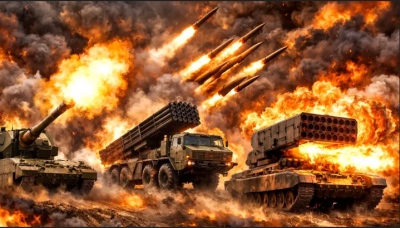
Iran has long been known for its innovation in low-cost, high-impact tactics, commonly referred to as asymmetric warfare. In January of last year, according to Iranian reports, the IRGC demonstrated a new sea-minelaying tactic during a naval exercise, utilizing the Fajr-5 MLRS from land to disperse mines into the sea. Analysts at the time called the tactic "innovative" yet "deeply concerning," as it meant the IRGC could now scatter thousands of naval mines across vast maritime spaces with a single launch salvo. The Fajr-5 was first developed in the 1990s and is a 333mm medium-range rocket system typically used for launching artillery rockets. The system can launch up to four artillery rockets from a mobile, truck-mounted launcher. Each rocket carries a 175-kilogram fragmentation warhead designed to split into high-velocity shrapnel capable of hitting multiple targets. It features an operational range of roughly 75 kilometers and has been used primarily by ground forces for strikes against airfields and military bases. However, that 75-kilometer range also means that if the Fajr-5 is used for minelaying, it could cover the entire width of the Strait of Hormuz. Newer variants, such as the Fajr-5C, are equipped with high-precision navigation systems and can launch rockets up to distances of 130 kilometers.
How could the Fajr-5 be used to lay sea mines?
Iran has not officially confirmed that the Fajr-5 or any other missile system is currently being utilized for laying sea mines. Theoretically, instead of conventional explosives, the rocket's warhead could be packed with sea mines, as demonstrated during the IRGC's naval exercise in January 2025. After being launched from a truck on the coast, the mine-carrying rockets would fly over predetermined maritime coordinates and open their casing in mid-air. The unexploded sea mines would then be released, falling into the ocean. They could be equipped with small parachutes or other decelerating mechanisms designed to slow their descent and ensure a smooth entry into the water, preventing detonation upon impact. Once in the water, the mines would sink to the bottom or remain suspended beneath the surface. A single launch salvo could theoretically transport dozens, if not hundreds, of naval mines and scatter them throughout the narrow Strait of Hormuz. Such a tactic could overwhelm mine-clearing operations while simultaneously keeping Iranian speedboats safe from CENTCOM forces.
Which countries possess aerial minelaying capabilities?
According to the US Navy, the US already utilizes aircraft and specialized launch systems to deploy Quickstrike mines at sea. This is a shallow-water mine based on a 2,000-pound general-purpose bomb outfitted with minelaying kits, target detection devices, and tail wings, enabling rapid and accurate deployment from US Navy and Air Force aircraft. These mines can be dropped from distances of roughly 40 kilometers, well outside the range of enemy air defenses. Modern variants utilize the Joint Direct Attack Munition (JDAM) kit, allowing aircraft to release mines with far higher precision and from much greater altitudes. According to the US Navy, the JDAM is a guidance tail kit added to existing unguided bombs, converting them into precision-guided weapons.
Only in military exercises
So far, the US has used this tactic exclusively during training and test exercises. The most recent test took place in April, when the US Navy announced it had tested a new guided munition known as the GBU-75. This munition is capable of either striking naval targets or deploying sea mines from aircraft positioned hundreds of kilometers away. Experts argue that the US must accelerate the development of new methods for deploying naval mines, including land-based launches. Writing last year for the US Naval Institute, US Navy officer Adam Pace noted: "There remains an urgent need to find a solution that facilitates mine warfare while ensuring survivability, desired volume, and the necessary speed of deployment. Deploying naval mines from land relies on existing units and systems, such as Marine Littoral Regiments and Army Multi-Domain Task Forces, to expand the capability of land forces to influence the maritime domain."
New York Times: US military faces command crisis following Daniel Driscoll's resignation
The US military is expected to enter its most challenging period since the wars in Iraq and Afghanistan, following the resignation of Secretary of the Army Daniel Driscoll, reports The New York Times (NYT). "Driscoll's resignation was expected, yet it occurred during a period of intense turmoil as the largest branch of the US Armed Forces enters its most demanding phase since the conflicts in Iraq and Afghanistan," the report states. At the same time, as highlighted by the NYT, the US military is facing severe leadership issues within its command structure. Following a series of dismissals and clashes attributed to Pentagon chief Pete Hegseth, the branch has essentially been left without a complete leadership framework. According to the report, Hegseth had previously forced at least three senior officers to step down from their posts. Now, the position of Secretary of the Army also remains vacant. According to the NYT, Hegseth would prefer to see Pentagon press secretary Sean Parnell appointed to the position. Earlier, Driscoll had officially submitted his resignation to US President Donald Trump.
Trump's bluff and 4 war scenarios
Amid this chaotic backdrop for the American military—recalling that generals and admirals recently pointed out that the war with Iran must not be prolonged because the force simply cannot sustain it—US President Donald Trump threatened a massive strike on the Strait of Hormuz in response to the Revolutionary Guard's attack on US bases in Jordan. However, the threat proved to be a bluff, as no attack took place in the early hours of September 1, contrary to what the American president had announced. Nevertheless, analysts do not rule out an attack occurring in the coming days and outline potential scenarios regarding how the conflict between the US and Iran might unfold.
A. Resumption of limited and controlled clashes The conflict model of the "Hormuz War" might repeat itself. This would entail a limited exchange of fire between Iran and the US—a controlled tension that neither escalates nor de-escalates, but continuously creates a state of war between the two sides. These clashes, much like in the "Hormuz War," could remain contained and conclude within a timeframe ranging from one week to a month.
B. Limited and gradually de-escalating conflict Another possibility is that the skirmishes remain extremely limited and gradually decrease in intensity. In this scenario, the daily exchanges of fire would diminish each night compared to the previous one, ultimately coming to a complete stop after a few days.
C. Escalating conflict – a path toward explosive tension Another potential scenario involves both sides engaging in exchanges of fire that become progressively heavier each night. This would mean the war escalates daily, driving both nations toward a major confrontation comparable to the "39-day war."
D. An unexpected last-minute retreat There is also the possibility of no fire being exchanged between the two sides at all. This could occur at the last minute if Trump decides to back down. For instance, he might claim in a social media post that the Iranians requested negotiations and that he decided to postpone the attack on Iran. Trump has repeatedly resorted to such tactics in the past, and it remains plausible he could utilize them once more.
Which regions could find themselves in the line of fire?
In scenarios "A" and "B," southern regions of Iran would likely be targeted once again. Under scenario "A," parts of the southern islands might be hit, whereas under scenario "B," targeting might be restricted to specific islands or limited coastal areas such as Sirik, Larak, and Qeshm. Under scenario "C," however, there is a distinct possibility of the conflict expanding into central provinces such as Isfahan and Yazd. If the war transforms into an all-out clash comparable to the "39-day war," then Tehran itself could be included among potential enemy targets. Conversely, under scenarios "A" and "B," Iran would likely restrict its strikes to US military bases in neighboring Arab nations such as Jordan, Bahrain, and Kuwait. Under scenario "C," should the conflict escalate further, strategic locations in key regional nations like Saudi Arabia, Qatar, and the United Arab Emirates could also be targeted. If the US attacks Tehran, Israel would likely become a target as well.
Will Israel get involved in the war?
In scenarios "A" and "B," it is considered unlikely that Israel would enter the war or face strikes from Iranian missiles and drones. Even under scenario "C," Israel would likely re-enter the conflict directly only if the US decides to return to an all-out war similar to the "39-day war." Otherwise, Tel Aviv will likely operate primarily behind the scenes, providing the US with logistical and intelligence support.
www.bankingnews.gr










Σχόλια αναγνωστών