

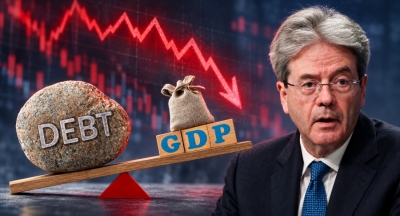
France has one of the highest fiscal deficits as a percentage of GDP among the 21 Eurozone countries, while its public debt is increasing
Markets are sounding the alarm bell, as France sinks into an ever-deepening debt crisis, awakening memories of the 2009 Greek drama. The surge in borrowing costs, political instability, and the economic slowdown intensify concerns over the endurance of the Eurozone's second-largest economy, while analysts and investment firms examine the risk of crisis contagion across Europe. Indicatively, France's borrowing costs, as reflected in its 10-year government bond yield, surpassed 5% this week for the first time since 2002, before moving even higher. Concurrently, the yield spread between 10-year French and German bonds—a metric closely monitored by markets to assess financial stress—surpassed 170 basis points on Thursday, for the first time since the Eurozone debt crisis in the early 2010s.
The risk of crisis contagion in the Eurozone
The primary concern involves Eurozone fragmentation, namely the situation in which countries sharing the same currency face significantly differing borrowing costs. This heightens market pressures and could lead to a vicious cycle of escalating debt repayments for the worst-affected nations. As the Eurozone sovereign debt crisis demonstrated in the early 2010s, market pressures in one country can spread rapidly to other economies sharing the same currency and central bank, yet possessing separate fiscal systems. The crisis began in Greece and subsequently expanded to countries like Portugal, Ireland, Italy, and Spain. Governments were forced to rescue troubled banks holding large quantities of sovereign bonds, creating a vicious cycle of mutually reinforcing problems. The crisis de-escalated only after the implementation of rescue programs linked to extensive austerity measures, as well as the commitment made in 2012 by then European Central Bank President Mario Draghi that he would do "whatever it takes" to save the euro. Economists warn that a new vicious cycle is taking shape today, not only in France, but also in major economies from the US to the United Kingdom. Investors' concerns over rising debt lead to higher bond yields and increased debt servicing costs, a fact that in turn further burdens public finances. "The slowdown in bond markets reinforces the risk that the state may be forced to default because it simply won't have the necessary cash to pay interest and principal on its debt," Nobel laureate economist Paul Krugman wrote in a post on October 8. "The fear of default subsequently leads to even greater capital flight, which reinforces default fears and raises interest rates," he added.
The risks for French debt
France has one of the highest fiscal deficits as a percentage of GDP among the 21 Eurozone countries, while its public debt is increasing. Its economy has nearly stagnated, with the government cutting its growth forecast for 2026 to just 0.5%. Fiscal pressures coincide with political instability and social unrest, which heighten doubts over whether the government can push through the measures required to stabilize public finances. "We have entered deep into a French crisis situation," stated Carsten Brzeski of ING and its chief economist for the Eurozone via email. "There is no immediate liquidity risk for the French government. However, the lack of confidence from the bond market and the ongoing crisis should finally provoke a strong sense of urgency in Paris." John Stopford of Ninety One noted that France has shifted from the category of core or semi-core European countries for fixed-income investors toward Europe's periphery. He characterized this development as "paradoxical," given France's historic position in the European Union and its economic power. "As investors, we have chosen for now to avoid nearly all non-core European countries. The situation is constantly changing and there is so much uncertainty that we really don't want to get involved," he stated.
Why 2026 is different
Despite concerns, analysts speaking to CNBC broadly agreed that reforms and measures adopted since then limit the risk of crisis contagion, even if markets display similarities to the post-financial crisis period. Stopford estimated that French bond spreads would likely have to move above 200 basis points for the situation to be widely considered a real crisis. He added, however, that "the situation in France does not look good."
"French spreads are now higher than those recorded at the peak of the peripheral countries' crisis in the early 2010s. However, they remain much lower than the extreme levels we saw back then in Spain, Italy, Greece, and Ireland," he told CNBC. In his assessment, markets consider that the situation will have to deteriorate further before European institutions examine the possibility of intervening to contain the damage.
Strategists at BlackRock noted that the current environment differs substantially from the one preceding the 2011–2012 Eurozone crisis. The region is now better equipped to handle financial stress, without this ruling out new turmoil and impacts on other economies.
"The sell-off in French bonds demonstrates how competition to attract capital is reshaping fixed-income markets amid a global interest rate realignment," they noted, adding that rising government borrowing and investments linked to artificial intelligence raise funding costs, exposing borrowers with deteriorating economic fundamentals to greater investor scrutiny. George Lagarias of Forvis Mazars argued that France is already in a debt crisis.
He cited the fact that the public debt-to-GDP ratio reached 119% at the end of the second quarter of 2026, a figure close to the 128% recorded by Greece at the end of 2009. Contagion, according to him, would be reflected in a further widening of the yield spread between French and German bonds, followed by an increase in credit default swap costs. "Italy and Spain would face higher borrowing costs and be forced to restrict their fiscal spending, something that would potentially trigger domestic political reactions," he told CNBC.
"The European periphery would come under immense pressure, even if its public finances are in much better shape than a few years ago." However, Mr. Lagarias estimated that critical structural differences limit the risk of a broader contagion similar to that of the early 2010s. He placed the probability of such a scenario at 10% to 20%. "Greece had a very large trade deficit. France also has a trade deficit, but the magnitudes are much milder," he noted. According to him, French statistical agency Insee is unlikely to present inaccurate deficit data, unlike what occurred in the Greek case.
In 2009, Greece sharply revised its fiscal deficit forecast from 3.7% of GDP in the spring to 12.5% in October. The revision undermined confidence in the reliability of its public finances and contributed to accelerating the crisis. "France's debt levels cause concern, but they are known. Markets can manage known risks. What they cannot tolerate are surprises," Mr. Lagarias added. "What sank Greece was a deficit that was suddenly revealed to be five times higher than the official estimate. That triggered the crisis."
Alex Everett of Aberdeen Investments agreed that the current situation should be treated "primarily as a French risk rather than a systemic risk for the entire Eurozone." "Compared to the early 2010s, the Eurozone possesses stronger banks, greater interconnection, and more tools designed to limit the risk of financial fragmentation among states," he noted. "I estimate that any crisis contagion will be short-lived."
www.bankingnews.gr











Σχόλια αναγνωστών