

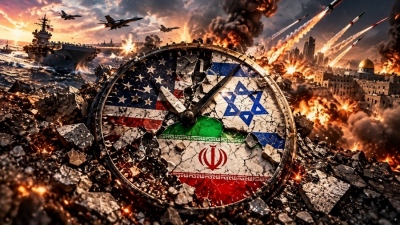
At the moment when US Secretary of State Marco Rubio maintains that an agreement with Iran is impossible as long as attacks in Hormuz continue and while Trump threatens that the time has come to make the final decision on whether the US will prevail through peaceful or non-peaceful means, Iranian generals and officials send their own message: the decision is final, we are ready for total war. Amid this explosive backdrop, the grand question posed by numerous analysts is whether the US is genuinely prepared for Iran's military—and broader—response should it launch a fresh offensive alongside Israel. Tehran has warned that its retaliation will extend beyond the Persian Gulf and Middle East region all the way to Europe, maintaining that it has "locked in" new targets, such as the 7 major underwater cables traversing the Strait of Hormuz; the destruction of which could trigger the collapse of a massive portion of the Internet. Under this light, it will prove exceptionally interesting to "reveal" what the next move of the US and President Trump will be.
Are the US prepared?
As tensions between Tehran and Washington escalate, a fundamental question arising is whether the United States is prepared for the consequences of a potential decision by Donald Trump to resume military strikes against Iran. Analysts point out that the primary concern is not exclusively restricted to Iran's defensive capabilities. It also concerns the scale of a potential response by Tehran, the security of American forces in the region, energy transport routes, and the risk of the conflict spilling over into other nations.
Iran's response
In the event of a broader military offensive, Tehran might extend its response beyond immediate American targets. Under such a scenario, military bases, strategic installations, and American interests in the region could find themselves under threat. Concurrently, the prospect of organizations allied with Iran in Iraq, Lebanon, and Yemen participating intensifies worries that a limited confrontation could evolve into a regional war. Nonetheless, the scale and intensity of such a response will depend on the magnitude of a potential American strike, the nature of targets selected, and Tehran's political and military calculations.
What will happen in Hormuz
One of the most significant points of vulnerability in this equation is the Strait of Hormuz. Any widespread disruption of navigation in the area could hike maritime transport and vessel insurance costs, triggering a fresh shock across the global energy market. Consequently, even if military strikes were restricted to a specific geographic zone, their economic impacts could ripple far beyond the Middle East. Surging oil and fuel prices could likewise intensify economic pressures on consumers and energy-importing governments, particularly ahead of winter.
The difficulty of predicting Tehran's response
One of the principal challenges for the United States is uncertainty regarding the form and intensity of the Iranian reaction. Tehran might confront a limited strike against Iranian military targets with a more measured response. However, a widespread strike against Iranian infrastructure or strategic facilities could alter respective calculations. In such an instance, American readiness cannot be evaluated solely on the basis of the number of fighter jets, warships, and air defense systems the US possesses. Protecting American forces and bases in the region, safeguarding navigation, countering missile and drone attacks, and preventing the war's expansion onto multiple fronts constitute integral parts of this equation. As the number of prospective targets mounts and the geographic expanse of the conflict broadens, controlling the war's trajectory grows increasingly arduous. Even successful interception of a portion of attacks does not necessarily preclude economic and political losses.
The core question
Ultimately, the core question is not whether the United States possesses the capacity to execute a new military strike. The substantive issue is whether Washington can manage the foreseeable and unforeseeable consequences of such an action. An offensive initiated with the objective of upping pressure on Tehran could culminate in a broadened conflict, disruptions in the energy market, and mounting political and military costs for the American administration. As long as both sides fail to reach an accord regarding terms for ending the crisis, the risk of miscalculations and a regression into generalized conflict will continue to persist.
Shock warning: The war will be total
A senior Iranian security official maintained that his country has prepared for a total, multi-layered, and generalized war. Speaking exclusively to Press TV, the informed security source stated the country has taken a "final decision" to respond to any hostile attack, alongside assassinations and targeted eliminations, "without any restriction or restraint." According to him, Iranian armed forces stand at full readiness "to strike with all their might the interests and targets of the aggressors and their supporters in the region who fall within their range." The official's statements underscore Tehran's stance that its response to any hostile act will not be subject to limitations or restraint. Per the official, Iran's decision is final, and any new military strike will be met with retaliation targeting the interests and strategic objectives of attackers and their supporters across the entire region.
US and Israel will attack together
The official likewise stated that, from Iran's perspective, the United States will not launch an attack without the participation of the Israeli regime, just as the Israeli regime will not attack without US participation. He characterized the prospect of either side acting independently in a war against Iran as resembling a "bitter joke," emphasizing the tight interconnection of the American and Israeli war machines. The official further asserted that explicit threats by American officials and the Israeli regime to strike Iran provide Tehran with the legal and moral legitimacy to enact necessary defensive measures.
Rezaei (Iranian general): No negotiations
Major General Mohsen Rezaei, secretary of Iran's Supreme National Security Council (SNSC), stated that "there will be no negotiations" with the United States until Washington proceeds with confidence-building steps. "This process must begin with the full fulfillment of all conditions set by Iran," Rezaei stated in a post on the X platform. Iranian Parliament Speaker Mohammad Bagher Ghalibaf similarly stated that achieving a permanent ceasefire with the US depends on satisfying the seven conditions set by Tehran for Washington. "It was the United States that, due to miscalculations and the war against Iran, found itself trapped in a quagmire. Now they are the ones who must proceed with necessary actions to extricate themselves," Ghalibaf stated during his meeting with Pakistani Army Chief General Asim Munir in Tehran on Tuesday.
Rubio (US SecState): An agreement is extremely difficult
The US remains in contact with various countries regarding the prospect of holding negotiations with Iran, said US Secretary of State Marco Rubio, maintaining however that a peace agreement with Iran is extremely difficult as long as it continues attacks in Hormuz. "Several countries are participating in efforts for negotiations with Iran. We welcome mediation initiatives," Rubio told reporters, making special mention of Qatar's enduring role. Nonetheless, Rubio clarified that "at the end of the day, any decision regarding what can be accepted will rest in the hands of the President" of the US. "The US will not support any agreement paving the way for Iran to acquire nuclear weapons. As long as President Trump is in power, Iran will not acquire nuclear weapons," he underlined. For its part, Iran reassures that it does not seek the acquisition of nuclear weapons, insisting that uranium enrichment on its soil constitutes a sovereign right of the country.
Trump: Iran's "dream" is for the war to continue past US midterms
US President Donald Trump stated that it constitutes Iran's "dream" for the war with the United States to continue past the November midterm elections. Speaking at a campaign rally in Greenville, North Carolina, the American President told his supporters: "Well, it's going to end very quickly. Once the war ends—and it will end one way or another very soon—oil prices will plummet." Trump added that rising oil prices represent "a very small price to pay to prevent the world's leading state sponsor of terrorism from acquiring a nuclear weapon." "All that remains is to make the final decision on Iran. In what manner do we want to prevail? Through peaceful means or non-peaceful means? In any case, we are making very good progress," said Trump, who when asked about what Pete Hegseth discussed with Benjamin Netanyahu during his visit to Israel, replied: "I can't talk about that right now. No."
Your bombs will detonate elsewhere
Tehran responds to ongoing American threats by brandishing its missile power, the capabilities of its domestic defense industry, and, above all, the strategic significance of the Strait of Hormuz, which constitutes a decisive leverage factor in confrontation with Washington. Acting Defense Minister Brigadier General Seyed Majid Ebn al-Reza argued that repeated American threats will not break Iran, emphasizing that the country possesses greater defense capabilities than it presents publicly. As he noted, Iranian defense industry production lines continue operating while advanced weapon systems are developed. He warned further that in the event of a new conflict, Iran will deploy technologically upgraded assets. Tehran's message is encapsulated in the striking warning: "Your bombs will detonate elsewhere: on your international credibility, the American economy, and even your electoral correlations!"
The strategic weapon of Hormuz
Special weight attaches to statements by Iranian Army Chief Major General Amir Hatami, who clarified that restrictions on transit through the Strait of Hormuz will continue unless the rights of the Iranian people are respected. Potential prolonged disruption of navigation could provoke turbulence in energy markets, fuel price hikes, overburdened maritime transport, and significant economic consequences internationally. Even more specific appeared Admiral Habibollah Sayyari, who on October 15 stated that the Strait of Hormuz remains closed and any transit requires prior coordination. Per him, the Navy of the Revolutionary Guards controls the western portion of the Strait, while regular army forces deploy in the eastern portion, stretching to the northern areas of the Sea of Oman. For Tehran, the Strait constitutes a lever of geopolitical and economic pressure: Iran's security is directly tied to the security of international energy flows. Hatami identified four pillars of Iranian power: the people, the armed forces, state structures, and the country's geopolitical position. He also argued that despite the loss of commanders and officials, military operations and state mechanisms continued functioning, averting the disorganization that, according to him, the adversary sought.
CENTCOM: They have no money
Iranian authorities rejected claims that Iran is unable to support its regional allies, acknowledging nevertheless that American sanctions and the war have provoked economic hardships. US Central Command (CENTCOM) chief Brad Cooper argued last week that the combination of military strikes and the naval blockade of Iran's southern ports "has inflicted severe blows" on the country. The American admiral stated that the US has blocked Iranian crude oil exports valued at least $25 billion and contributed to freezing cryptocurrency assets totaling roughly $350 million. According to him, this means the Islamic Revolutionary Guard Corps (IRGC) can no longer pay soldier salaries, while regional organizations linked to Iran likewise face financing deficits. "The economic pressure on Iran's armed forces has become so significant that there are reports pro-Iranian militias across the region are withholding payments to their fighters in order to funnel money back to the Revolutionary Guards, who are also failing to pay their personnel," Cooper stated. This evolution is presented as a US victory in its war with Iran, which thus far has yielded meager tangible successes for Washington.
Financing the "Axis"
For decades, the Quds Force of the Revolutionary Guards has provided cash, weapons, components, training, and manufacturing know-how to allied organizations in the region. According to United Nations experts and American officials, this support has enabled organizations in confrontation with the US and Israel to assemble or manufacture various weapon systems locally. Organizations of the so-called "Axis" likewise draw financing from business activities, encompassing oil exports, alongside donations and local resources. The US Treasury Department has argued that commercial networks of allied organizations in Iraq sell Iranian products and distribute revenues via intermediaries and currency exchange bureaus.
Iran maintains no "collapse" is imminent
The Iranian economy has sustained successive blows over recent years due to war, internal mismanagement, and international sanctions. These evolutions have driven runaway inflation, low wages, national currency devaluation, and isolation from the international community for Iran's 90 million residents. Improvement prospects remain constrained, as the World Bank projected earlier this month a contraction of the Iranian economy by 7.7% in fiscal year 2026–2027. Nonetheless, authorities emphasize that these difficulties do not affect their resolve. Concurrently, they dispute US Treasury estimates according to which economic pressure could lead the Iranian leadership to lose control within months. " Despite all these pressures, the Iranian economy has demonstrated very high resilience, and the claim that Iran's economy is collapsing is nothing more than an illusion," Central Bank Governor Abdolnaser Hemmati stated earlier this month.
Economic problems
President Masoud Pezeshkian acknowledged Sunday that military strikes and the naval blockade have generated severe problems for the country. Nevertheless, he underlined that his government relies on domestic productive and economic capabilities to withstand pressures. Pezeshkian argued that consumption management has now eliminated the need for gasoline imports, which would otherwise cost $12 billion, provided American pressures permitted the execution of such imports. The Iranian President likewise pledged that revenues from recent fuel price hikes will be returned to households via a modest increase in the value of electronic food purchase coupons. Negar Mortazavi, a senior researcher at the Center for International Policy based in Washington, stated she expects Tehran to continue prioritizing its allied organizations in the region despite the economic pressures entailed by supporting them. "Economic pressure certainly limits Iran's military resources, but this does not mean it will radically alter the strategic calculations of the Revolutionary Guards or force Tehran to capitulate," Mortazavi told Al Jazeera.
www.bankingnews.gr







Σχόλια αναγνωστών